

India has always been known for innovative farmers who constantly experiment with crops, farming methods, and cultivation techniques. From growing exotic fruits in challenging climates to developing unique agricultural practices, many farmers across the country continue to prove that passion and dedication can create extraordinary results.
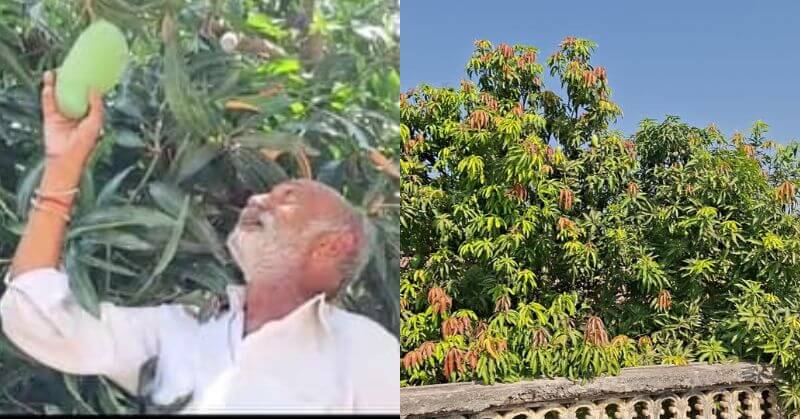
Recently, one such farmer from Gujarat has grabbed widespread attention for doing something that sounds almost unbelievable at first. A farmer from Amreli district has successfully managed to grow 14 different varieties of mangoes on a single tree. Yes, one tree carrying mangoes of different colours, flavours, sizes, and textures.
The remarkable farming experiment has now become a major talking point among agriculture enthusiasts, horticulturists, and social media users alike. Many people are travelling to his village just to witness the unique mango tree with their own eyes.
Meet Ukabhai Bhatti From Gujarat
The farmer behind this fascinating experiment is Ukabhai Bhatti, a progressive farmer from Ditala village in Dhari taluka of Gujarat’s Amreli district.
Bhatti has been making headlines after successfully cultivating multiple mango varieties on a single tree using grafting techniques and scientific farming methods.
According to reports, the experiment started simply out of curiosity and passion for farming innovation. In an interview with ETV Bharat, Bhatti explained that he initially treated the idea as an experiment to see whether it would actually work.
He reportedly said that the successful outcome gave him immense satisfaction.
What makes the story even more interesting is that this is not just about growing different mangoes together. Each variety maintains its own unique taste, colour, and texture despite sharing the same tree.
How Does One Tree Grow 14 Different Mangoes?
The secret behind Bhatti’s unique tree lies in grafting techniques, a scientific horticulture method that allows branches from different mango varieties to grow on one main tree.
Grafting has been used in farming for years, but successfully maintaining 14 mango varieties together on a single tree requires patience, expertise, and constant care.
According to media reports, Bhatti carefully used scientific methods to combine different mango species onto one healthy tree structure. Over time, the branches adapted successfully and started producing fruits independently.
During mango season, the tree reportedly becomes a stunning sight filled with mangoes of different shapes, colours, and flavours all at once.
The varieties growing on the tree include Kesar, Amrapalli, Langra, Badami, Gulabi, Rasbari, Jamadar, Kala Jamadar, Hapus, and Totapuri among others.
For visitors, seeing all these famous mango varieties hanging from one tree feels almost unreal.
A Rare Collection Of Mango Varieties
The experiment has become even more special because several of the mango varieties are considered rare today.
According to reports, people who tasted the fruits said some of the varieties were once popular during the nawabi era but are now difficult to find in regular markets.
A few species are also believed to originate from regions outside Gujarat.
That aspect has made the tree important not only from a farming perspective but also from a preservation standpoint. As commercial farming increasingly focuses on only a few profitable fruit varieties, several traditional mango species slowly disappear over time.
Bhatti’s experiment is now helping preserve those rare varieties in a practical and visible way.
For mango lovers, the tree has almost become a living collection of India’s diverse mango heritage.
People Are Visiting The Village To See The Tree
As news about the experiment spread, people interested in farming and horticulture started visiting Ditala village to witness the tree personally.
According to reports, agriculture enthusiasts, local farmers, and curious tourists have all shown interest in Bhatti’s work.
Many visitors reportedly ask questions about grafting techniques, plant maintenance, and the scientific process involved in growing multiple fruits on one tree.
The viral attention has also brought recognition to innovative farming practices that often go unnoticed outside rural communities.
Social media users too have reacted with amazement after videos and images of the tree began circulating online. Several people called it a “wonder tree,” while others praised the farmer’s dedication and patience. For many viewers, the experiment highlighted how much innovation already exists within Indian agriculture.
What Horticulture Experts Are Saying
Horticulturists and agriculture experts have also appreciated Bhatti’s experiment.
According to experts, such innovative farming techniques can encourage more farmers to explore scientific cultivation methods rather than relying only on traditional approaches.
They also believe experiments like these can play an important role in preserving rare fruit species that are slowly vanishing due to changing agricultural trends.
Experts often point out that biodiversity in farming is extremely important for long-term sustainability. Preserving older fruit varieties helps maintain genetic diversity and protects traditional crops from disappearing completely.
Bhatti’s work is now being seen as a small but meaningful contribution towards that effort.
Farming Innovation Is Changing Indian Agriculture
Over the last few years, many Indian farmers have started experimenting with modern and scientific methods to improve cultivation.
Some focus on organic farming. Others explore hydroponics, vertical farming, or rare crop cultivation. Social media has also helped bring visibility to these unique success stories.
Earlier this year, discussions around unusual mango cultivation had already gained attention after farmer Shree Kishan Suman from near Kota became known for growing Sadabahar Mango three times a year. Even industrialist Anand Mahindra had encouraged his efforts online.
Now, Ukabhai Bhatti’s story has added another fascinating chapter to India’s growing list of agricultural innovations.
These stories continue to inspire younger generations to view farming not just as traditional labour, but also as a field full of experimentation and creativity.
What This Experiment Really Teaches Us
Beyond the viral attention and social media praise, Bhatti’s experiment carries a much bigger message.
It proves that innovation is not limited to laboratories or big companies. Sometimes, groundbreaking ideas can emerge from small villages through patience, observation, and dedication.
The experiment also shows how passion for agriculture can lead to remarkable results when combined with scientific thinking.
More importantly, it reminds people that farming continues to evolve constantly. New methods, creative ideas, and careful research can completely transform traditional agriculture practices.
Conclusion
Ukabhai Bhatti’s 14-variety mango tree has become much more than just a farming experiment. It has turned into a symbol of innovation, dedication, and the endless possibilities within agriculture.
From preserving rare mango species to inspiring fellow farmers, his work is now attracting attention far beyond Gujarat’s Amreli district.
At a time when agriculture often struggles for recognition, stories like these remind people that farmers are not just cultivators. Many of them are innovators quietly creating extraordinary things through passion and perseverance.
Follow Us: Facebook | Instagram | X |
Youtube | Pinterest | Google News |
Entertales is on YouTube; click here to subscribe for the latest videos and updates.