

Monthly subscriptions have quietly become an essential part of everyday life. What once started with entertainment platforms like Netflix and Spotify has now expanded into almost every aspect of the digital world. Today, people pay recurring monthly fees for AI tools, fitness apps, cloud storage, food delivery memberships, online learning, and even beauty services. For many Gen Z users and Millennials, these subscriptions are no longer occasional purchases but a regular part of their monthly budget.
However, as the number of subscriptions grows, so does the overall cost. Small recurring payments may appear harmless individually, but together they can take up a significant share of disposable income. This growing trend, often referred to as “subscription creep,” is prompting consumers to rethink how they manage their finances.
Subscriptions Have Become A Lifestyle
The subscription economy has evolved rapidly over the last few years. Consumers are increasingly choosing access over ownership, paying monthly for convenience, entertainment, productivity and personal growth.
Illustrative spending estimates shared by Viral Pitch suggest that an active Gen Z consumer could spend anywhere between Rs 2,600 and Rs 7,450 every month across different subscription categories.
For Millennials, the monthly spending is even higher, ranging from Rs 5,200 to Rs 11,700, reflecting higher disposable incomes and a greater preference for premium plans and family memberships.
Although most people do not subscribe to every available service, the estimates highlight how recurring payments have become an important part of household expenses.
AI Is Becoming As Essential As Streaming Services
One of the biggest shifts in recent years has been the rapid rise of artificial intelligence subscriptions. Consumers are now paying between Rs 500 and Rs 1,500 every month for AI-powered platforms such as ChatGPT Plus, Canva Pro and Notion AI.
Among Millennials, spending on AI subscriptions rises further to approximately Rs 1,000 to Rs 2,500 each month. Unlike entertainment subscriptions, AI tools are increasingly viewed as investments rather than expenses.
Students use them to improve learning. Freelancers depend on them to increase productivity. Marketers rely on them for content creation, while entrepreneurs use them to streamline daily operations. For many professionals, AI subscriptions are gradually becoming as essential as cloud storage or office productivity software.
Where The Money Goes Every Month
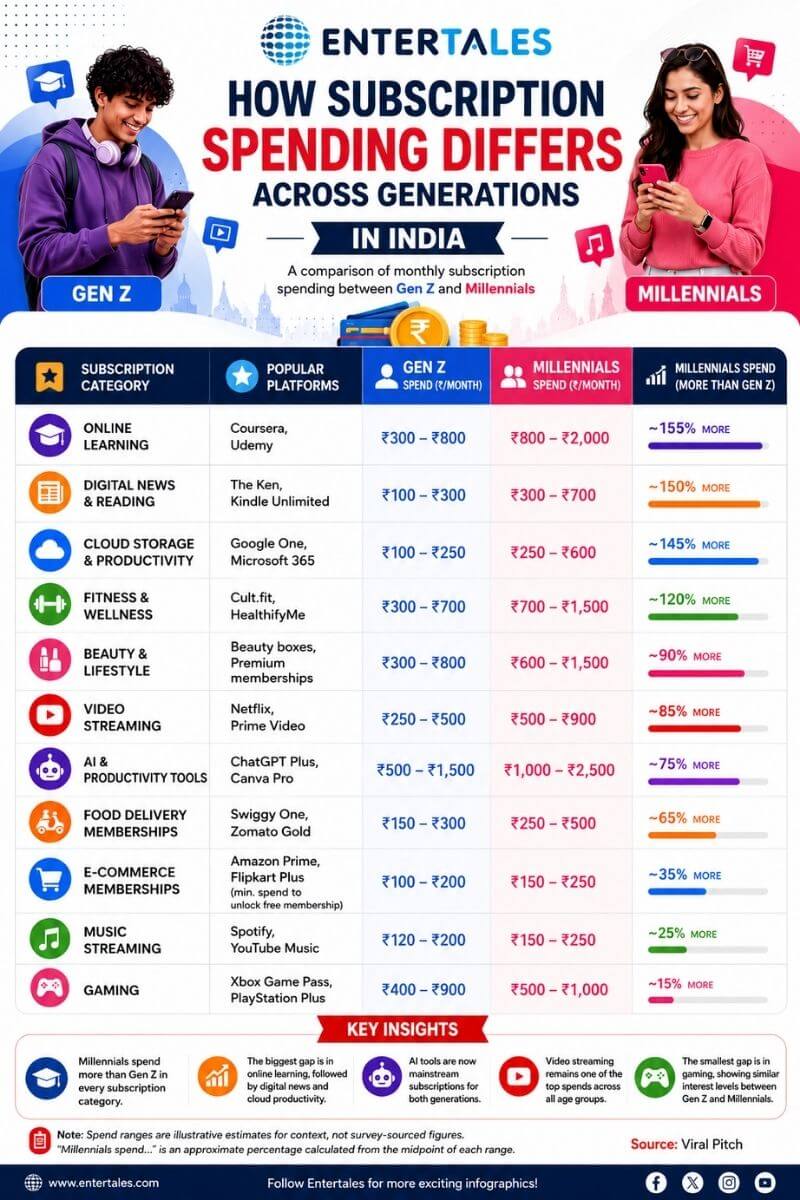
According to the illustrative estimates, spending patterns vary across different subscription categories.
- Online learning platforms such as Coursera and Udemy account for approximately Rs 300-800 per month for Gen Z and Rs 800-2,000 for Millennials.
- Digital news and reading services like The Ken and Kindle Unlimited range between Rs 100-300 for Gen Z and Rs 300-700 for Millennials.
- Cloud storage and productivity services, including Google One and Microsoft 365, typically cost Rs 100-250 monthly for Gen Z compared to Rs 250-600 for Millennials.
- Fitness and wellness subscriptions remain another major expense, with Gen Z spending around Rs 300-700, while Millennials spend Rs 700-1,500.
- Entertainment platforms also continue to attract significant spending. Video streaming services like Netflix and Prime Video cost approximately Rs 250-500 for Gen Z and Rs 500-900 for Millennials.
- Music streaming platforms such as Spotify and YouTube Music remain among the most affordable subscriptions, generally ranging from Rs 120-200 for Gen Z and Rs 150-250 for Millennials.
- Gaming subscriptions, including Xbox Game Pass and PlayStation Plus, see spending of Rs 400-900 among Gen Z and Rs 500-1,000 among Millennials.
- Food delivery memberships, e-commerce subscriptions, beauty memberships and other lifestyle services also contribute to monthly recurring expenses.
Millennials Spend More Across Most Categories
The estimates indicate that Millennials consistently outspend Gen Z across nearly every subscription category. Higher incomes, family plans and a stronger focus on long-term investments like education, health and productivity explain much of the difference. Fitness subscriptions, for example, cost Millennials more than twice as much in many cases. Similarly, spending on online learning platforms also rises significantly among older consumers.
Gen Z, meanwhile, continues to prioritise entertainment, gaming, food delivery and AI tools, reflecting a lifestyle built around convenience, digital experiences and continuous skill development. Commenting on the trend, Sumit Gupta, Founder of Gurugram-based AI-powered digital marketing platform Viral Pitch, said:
“Gen Z and Millennials aren’t just buying services; they are subscribing to identities. We are witnessing a macroeconomic shift where these generations prioritise lifestyle velocity and flexibility over traditional ownership. Subscriptions have officially evolved from transactional conveniences into continuous relationship baselines across fashion, fitness, and fintech.”
He further added:
“To win their loyalty, brands must move past the concept of a recurring payment gate. The modern subscription economy belongs to organisations that leverage data-driven personalisation and creator-led community building to establish authentic trust. Ultimately, the lifetime value of a customer is no longer won at checkout.”
The Hidden Cost Of Subscription Creep
While each subscription may appear affordable on its own, together they can quietly consume a sizeable portion of monthly income. Automatic renewals make the situation even more challenging, as consumers often continue paying for services they rarely use. Gupta also highlighted the importance of delivering continuous value to subscribers.
“For today’s consumer, loyalty is continuously earned through transparent pricing, systemic utility, and consistent cultural relevance; values anchored deeply in social proof and shared digital identity.”
According to experts, even cancelling a few underused subscriptions can save thousands of rupees over the course of a year.
Conclusion
The subscription economy is changing the way younger generations spend and manage money. From entertainment and food delivery to AI-powered productivity tools, recurring payments have become a normal part of everyday life. While these services often improve convenience, learning, health and work efficiency, they also require careful financial planning.
Experts believe the smartest approach is not to eliminate subscriptions altogether but to choose them wisely. Regularly reviewing recurring payments and keeping only those that genuinely add value can help consumers enjoy the benefits of digital services without placing unnecessary pressure on their monthly budgets.
Follow Us: Facebook | Instagram | X |
Youtube | Pinterest | Google News |
Entertales is on YouTube; click here to subscribe for the latest videos and updates.