

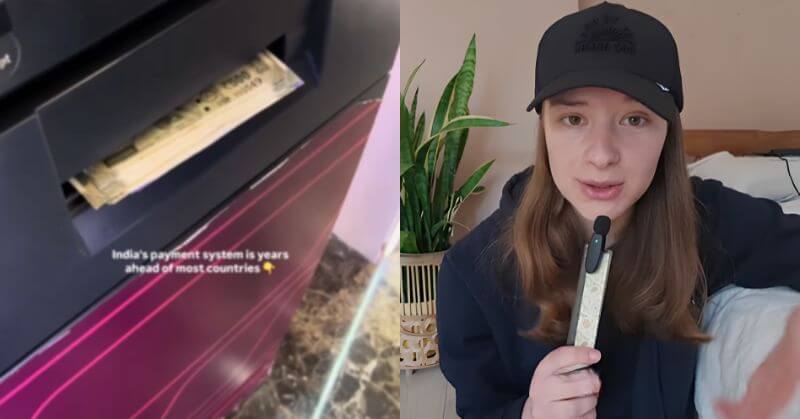
India’s digital payment revolution has transformed the way millions of people buy, sell, and transfer money every day. From roadside tea stalls and vegetable vendors to shopping malls and restaurants, QR codes have become an almost universal sight across the country. What many Indians now consider routine continues to surprise visitors from around the world. Recently, Slovenian traveller recent Instagram post has gone viral.
Over the past few years, the Unified Payments Interface (UPI) has emerged as one of India’s biggest technological success stories. The system has made instant payments possible with just a few taps on a smartphone, reducing dependence on cash and simplifying transactions for businesses and consumers alike. While Indians use it daily without much thought, foreign travellers often find themselves amazed by how seamlessly it works.
During her visit to India, Slovenian traveller shared her experience using the country’s digital payment ecosystem and described it as being years ahead of what exists in many other parts of the world. Her observations have sparked conversations online, with many users agreeing that India’s payment infrastructure is among the most advanced globally.
Why India’s Payment System Impressed This Slovenian Traveller
The traveller, identified as Julija, visited India during her gap year and documented her experience on social media. In her now-viral post, she expressed surprise at how little cash she needed while travelling across the country. According to her, almost everywhere she visited offered digital payment options through QR codes, making transactions remarkably simple and convenient.
What impressed her most was the widespread acceptance of digital payments. Whether it was a small tea stall, a local shop, or a restaurant, she found that QR code-based payments were readily available. Instead of entering lengthy bank details or carrying large amounts of cash, users simply scan a code and complete a transaction within seconds. She described the experience as one of the easiest payment systems she had encountered while travelling.
Watch her viral video:
View this post on Instagram
Julija noted that India’s payment system felt significantly ahead of what she had experienced in many other countries. For travellers, convenience often plays a major role in shaping their impressions of a destination, and the ease of making payments left a lasting impact on her visit. However, she also pointed out that the experience can vary for foreign tourists because access to UPI-based services often depends on their banks and available international integrations.
Her comments quickly resonated with social media users. Many Indians expressed pride in seeing a foreign traveller praise a system they use every day. Others shared their own experiences of how UPI has simplified daily life, from splitting bills with friends to making payments at local markets without needing exact change.
The praise comes at a time when India’s digital payment ecosystem continues to receive international recognition. UPI has evolved from a domestic innovation into a global case study for digital financial inclusion. Several international organisations have acknowledged its scale, efficiency, and ability to make financial services accessible to millions of people. Today, the platform accounts for a significant share of global real-time payment transactions and continues expanding its international footprint.
The growth of UPI has been remarkable. What began as a payment solution aimed at simplifying money transfers has now become the backbone of India’s digital economy. The system supports instant bank-to-bank transactions and allows users to send or receive money using simple identifiers rather than complicated account details. This ease of use has played a major role in driving adoption across urban and rural India alike.
India’s success with UPI has also attracted global attention because of its scale. Industry experts and international institutions have frequently highlighted how the platform processes billions of transactions every month, making it one of the largest real-time payment networks in the world. The technology has even expanded beyond India’s borders through partnerships and payment linkages with multiple countries.
For many Indians, Julija’s reaction served as a reminder of how much the country’s payment landscape has changed within a relatively short period. What once required cash, cards, or lengthy banking procedures can now be completed almost instantly using a smartphone. The convenience has become so common that many people only realise its significance when they hear visitors compare it with systems in other parts of the world.
Conclusion
The Slovenian traveller’s viral post has once again highlighted how India’s digital payment ecosystem continues to impress visitors from across the globe. Her experience of making quick and effortless transactions through QR codes reflects how deeply digital payments have become integrated into everyday life in India.
While many Indians may take the convenience of UPI for granted, stories like this demonstrate the global impact of the country’s fintech innovation. As digital payments continue to expand internationally, India’s payment infrastructure is increasingly being viewed as a model for speed, accessibility, and financial inclusion.
For Julija, the experience was simple: she found a system that worked almost everywhere, required very little cash, and made travelling easier. For India, it was another example of how a homegrown innovation is earning recognition far beyond its borders.
Follow Us: Facebook | Instagram | X |
Youtube | Pinterest | Google News |
Entertales is on YouTube; click here to subscribe for the latest videos and updates.