
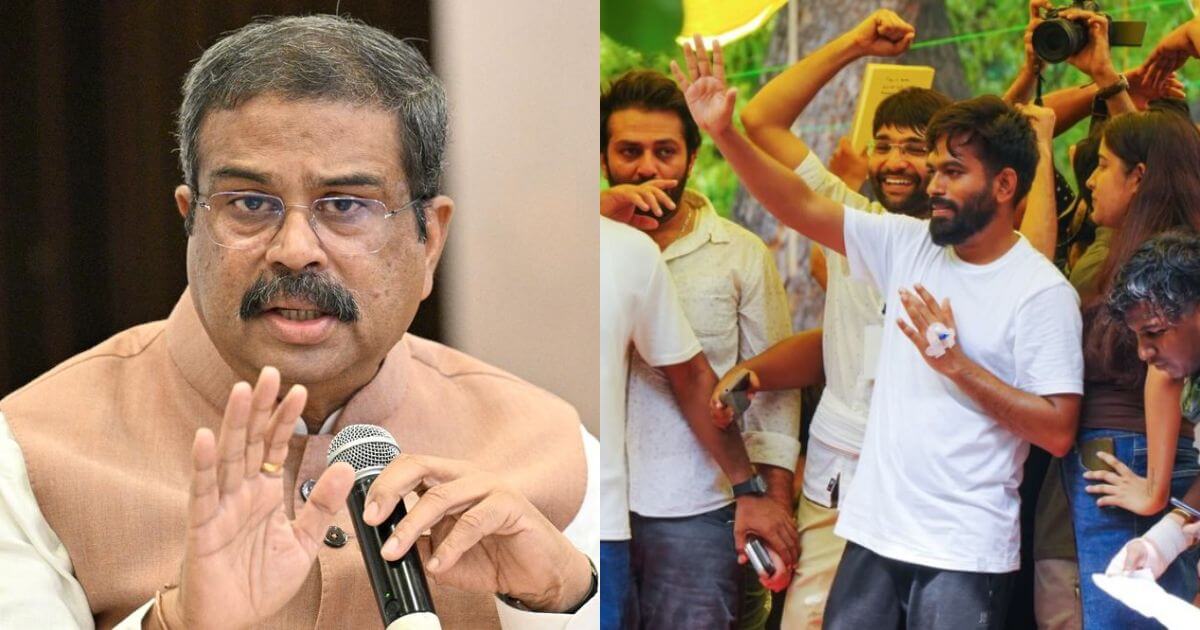
After weeks of nationwide protests over alleged examination irregularities and the NEET paper leak controversy, Union Education Minister Dharmendra Pradhan has stepped down from his post. His resignation marks a major political development following a month-long student agitation that kept the issue in the national spotlight and intensified pressure on the government.
Pradhan announced his decision through a post on X on Saturday, saying he had submitted his resignation to Prime Minister Narendra Modi. The announcement came just hours before the third round of talks between the Centre and the Cockroach Janta Party (CJP), the student-led group spearheading the protests. Soon after the resignation, the protesters called off their agitation, claiming that their key demands had been accepted.
Dharmendra Pradhan Announces Resignation
— Dharmendra Pradhan (@dpradhanbjp) July 25, 2026
Dharmendra Pradhan made the announcement on social media, expressing gratitude to Prime Minister Narendra Modi for giving him the opportunity to serve the country as Education Minister.
In his statement, he reiterated his commitment to India’s youth and said their aspirations had always remained at the centre of his public life. He wrote,
“I hold deep respect for the aspirations, sentiments, and rightful expectations of the youth of this country. Realising the dreams of India’s young generation has been the moral resolve of our political and social life. I express my gratitude to Hon’ble Prime Minister for the opportunity given to me to serve the nation under his visionary leadership.”
Pradhan also assured students that their future should never become a casualty of confusion or uncertainty. He added,
“It is my resolve that we will not allow the youth power of the country to be trapped in a web of confusion.”
“To Keep Anti-India Forces Away”
View this post on Instagram
In another part of his statement, Dharmendra Pradhan explained the reasoning behind his resignation. He said the decision was taken to ensure that anti-national elements do not exploit the ongoing protests and that students can return to focusing on their education. Pradhan stated,
“Keeping in mind that anti-national forces should not take advantage of the situation that has arisen at Jantar Mantar and across the country, that the unity of the nation remains intact, that the future of even a single student of India does not get entangled in legal complications, and that our children devote their time to studies and focus on building their careers — I have submitted my resignation to Hon’ble Prime Minister.”
The statement quickly became one of the most discussed political developments on social media.
Resignation Ends Weeks Of Deadlock
View this post on Instagram
The Education Minister’s resignation came just before the third round of negotiations between the government and the Cockroach Janta Party. For several weeks, discussions between both sides had remained stalled because the protesters insisted that Dharmendra Pradhan’s resignation was non-negotiable.
Earlier on Saturday, the CJP had made it clear that no further discussions would take place unless the government accepted their primary demand. The resignation significantly changed the course of the negotiations and paved the way for an agreement between both sides.
Protesters Call Off Agitation
DEMOCRACY WINS! 🇮🇳🇮🇳🇮🇳 pic.twitter.com/HpCaqBkPxc
— Cockroach is Back (@Cockroachisback) July 25, 2026
Soon after the meeting with Union Ministers JP Nadda and Jitendra Singh, the Cockroach Janta Party announced that it was withdrawing its month-long protest. According to the organisation, the Centre had agreed to its principal demands. The movement, which had been centred at Delhi’s Jantar Mantar for more than a month, officially ended on Saturday evening.
As news of Dharmendra Pradhan’s resignation reached the protest venue, celebrations broke out among the students. Supporters raised slogans and cheered, describing the resignation as a significant victory for the movement. The CJP later posted on social media, “Long Live Student Power.”
Addressing supporters from the stage at Jantar Mantar, CJP founder Abhijeet Dipke declared,
“We have done it.”
He further said,
“They used to say that no one resigns in this government. But we have done it.”
Key Demands Raised By Students
View this post on Instagram
The student movement had consistently focused on three major demands during its protest. The first and most prominent demand was the resignation of Education Minister Dharmendra Pradhan. The protesters also sought an assurance that no legal action would be initiated against students who participated in the demonstrations.
In addition, they demanded compensation for the families of students who allegedly died by suicide following the NEET paper leak controversy. According to the organisers, these demands were raised repeatedly during multiple rounds of discussions with government representatives.
Protests Grew Into A National Issue
What began as a protest over examination irregularities gradually expanded into a nationwide movement. Demonstrations spread across several cities, with students demanding greater accountability and reforms in the examination system.
The controversy also became a major political issue, with Opposition parties extending support to the protesters and questioning the government’s handling of the alleged paper leak. The sustained demonstrations kept pressure on the Centre and made education reforms one of the most debated public issues in recent weeks.
Against this backdrop, Dharmendra Pradhan’s resignation represents a significant political development in the ongoing controversy.
Focus Shifts To Education Reforms
With the protests now withdrawn, attention is expected to shift toward the implementation of reforms aimed at restoring public confidence in competitive examinations. Students have repeatedly demanded stronger safeguards against paper leaks, greater transparency in examination processes, and stricter action against those responsible for irregularities. The government’s next steps regarding these concerns will be closely watched by students, parents, and educational institutions across the country.
Conclusion
Dharmendra Pradhan’s resignation has brought an end to one of the country’s most closely followed student movements in recent years. His decision, announced amid ongoing negotiations with protesters, paved the way for the withdrawal of demonstrations that had continued for over a month.
While the resignation marks a major milestone in the controversy, the larger conversation surrounding examination reforms and accountability is far from over. With students expecting meaningful changes to prevent future paper leaks, the focus now shifts from protest sites to policy decisions that could shape the future of India’s education system.
Follow Us: Facebook | Instagram | X |
Youtube | Pinterest | Google News |
Entertales is on YouTube; click here to subscribe for the latest videos and updates.