

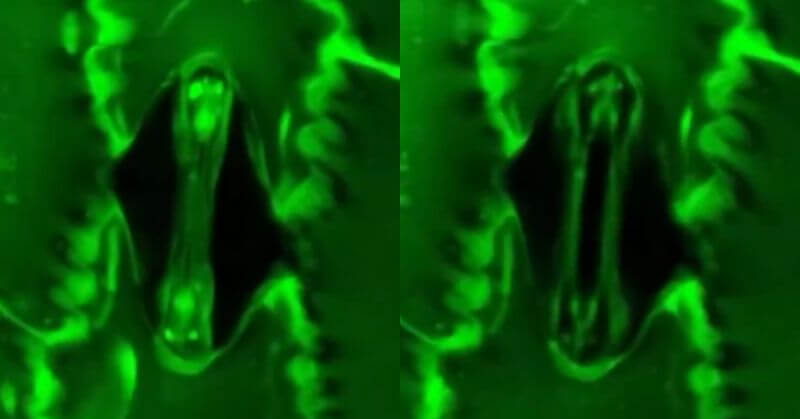
For centuries, scientists have known that plants quietly “breathe,” taking in carbon dioxide and releasing oxygen. But until now, this invisible process has remained just that — invisible. For the first time ever, researchers have found a way to actually watch plants breathe in real time. This breakthrough doesn’t just change how we study plant life; it could reshape agriculture, climate research, and the future of global food security in ways most people never imagined. Many people are shocked by what scientists are discovering, and here’s why it matters more than you might imagine.
That has been altered by researchers at the University of Illinois Urbana-Champaign. They have created a groundbreaking instrument that enables scientists to see plants’ breathing in real time, providing an unparalleled perspective on how plants react to their surroundings.
What Does ‘Breathing’ Mean For Plants?
Although they don’t breathe as humans do, plants are always exchanging gases with the atmosphere. This process is carried out through stomata, often described as the “mouths” of the plant. These tiny pores open and close to precisely balance the intake of carbon dioxide for photosynthesis with the loss of water through transpiration.
This complex mechanism allows plants to survive environmental challenges such as heat and drought.
The ‘Stomata In-Sight’ Device: What Is It?
Researchers can now directly observe stomatal activity as it happens thanks to a newly developed technology called Stomata In-Sight. It offers an unprecedented level of precision in tracking how gases enter and exit leaf pores.
How Does This Technology Operate?
Seeing Plants Breathe
Researchers have achieved a breakthrough in plant biology by developing a way to watch plants
“breathe” in real time.While we have known for centuries that plants exchange gases through microscopic pores called stomata, we have never before been able to… pic.twitter.com/j62H8y6mtk
— Brian Roemmele (@BrianRoemmele) January 15, 2026
The system combines a high-resolution confocal microscope, an accurate gas-exchange measurement setup, and real-time image analysis software.
Small pieces of leaves are placed inside a palm-sized chamber with precise control over temperature, humidity, light, carbon dioxide levels, and water supply. This setup allows scientists to record videos showing plants absorbing CO₂ and releasing oxygen and water vapour — key processes in photosynthesis and plant health.
What Did Researchers See In Real Time?
Using advanced sensors and imaging, researchers observed minute cellular changes as stomata responded to fluctuations in light, humidity, and temperature.
Stomata generally open in light to enable photosynthesis and close in darkness to reduce water loss. According to Andrew Leakey of the University of Illinois Urbana-Champaign, plant growth slows when stomata close more frequently due to water shortage or hot, dry conditions.
Why Did It Take So Long To Achieve This Breakthrough?
The system took over five years to develop. One of the biggest challenges was eliminating even the tiniest vibrations, which could interfere with ultra-thin microscopic images.
After testing several prototypes, the team eventually achieved a stable and reliable design capable of capturing this hidden process.
Why Is Agriculture Affected By This Discovery?
Understanding stomatal behaviour at this level could transform crop breeding. By identifying genetic traits linked to better water-use efficiency, scientists can now work toward developing crops that require less water to grow.
This breakthrough is especially important given rising concerns about climate change, water scarcity, and global food shortages.
How Can This Help Combat Heat Stress And Drought?
Water shortage remains one of the biggest threats to agricultural productivity. By studying how plants regulate water loss, researchers can help farmers adapt to increasing temperatures, prolonged droughts, and unpredictable weather patterns.
Does The Public Have Access To This Technology?
The technology has been patented by the University of Illinois Urbana-Champaign. Although it is not yet commercially available, experts expect it to be produced and shared with research institutions worldwide in the near future.
The findings were published in the peer-reviewed journal Plant Physiology, marking a major advance in plant biology research.
Conclusion
Seeing plants breathe in real time sounds almost surreal, but this breakthrough makes it possible. What was once an abstract concept taught in textbooks is now visible, measurable, and deeply informative. Beyond the wow factor, this discovery carries real-world implications — from growing crops with less water to safeguarding food supplies in a warming world. Sometimes, the quietest processes on Earth turn out to be the most powerful once we finally learn how to see them.
Follow Us: Facebook | Instagram | X |
Youtube | Pinterest | Google News |
Entertales is on YouTube; click here to subscribe for the latest videos and updates.