
A small amount of change has sparked a much bigger debate about tipping culture in India. A customer claimed that a waiter at a three-star restaurant kept Rs 80 from his payment without asking and later described it as a tip.
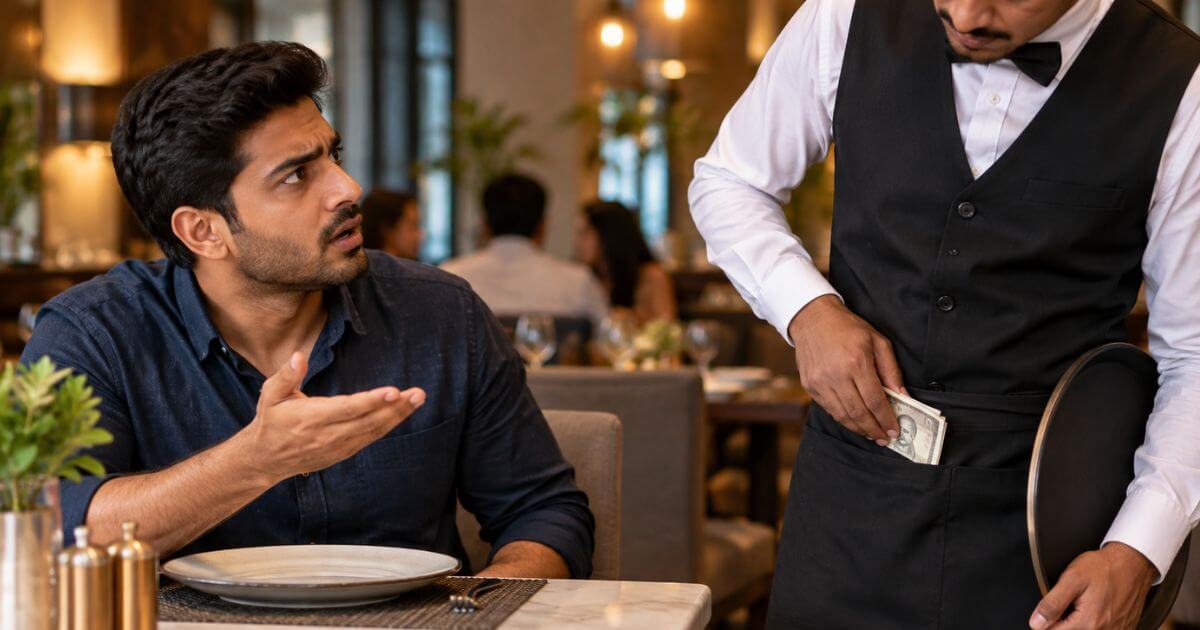
The customer had reportedly gone out for lunch with friends. Their bill came to Rs 920. He handed the waiter Rs 1,000 and expected the remaining Rs 80 to be returned. Instead, according to his account, the waiter pocketed the money and thanked him. What followed was an argument involving the customer, the waiter and the hotel manager.
Waiter Allegedly Keeps Rs 80 From Payment
🚨Shocking incident happened today 🚨
Had lunch with my friends at a 3 star restaurant today. The bill was ₹920 so I handed the waiter ₹1000. He smiled and said “Thank you so much sir”
I asked ‘What about the change ?’
He casually said that has been adjusted as the waiter’s…— Phunsuk Wangdu (@Phunsukwangduji) September 22, 2026
The customer shared his experience in a post on X, explaining how the incident unfolded. “Had lunch with my friends at a 3-star restaurant today. The bill was Rs 920, so I handed the waiter Rs 1000. He smiled and said. ‘Thank you so much sir,'” the user said in the post.
Initially, the customer appears to have assumed that the waiter was simply acknowledging the payment. However, when he realised that the Rs 80 balance was not being returned, he questioned the waiter about it. According to the customer, the response left him surprised. The waiter allegedly told him that the amount had been adjusted as a tip.
Customer Says He Never Agreed To Give A Tip
The customer said he initially thought the waiter was joking. He then questioned how the money could be treated as a tip without his permission. “I genuinely thought he was joking. When I questioned him how can you do this without my permission, he actually started arguing along with the manager, saying, ‘Customers are expected to tip for the service,'” the customer said.
The response became the central point of the customer’s complaint. He argued that leaving a tip should be the customer’s decision and not something automatically assumed by a restaurant or its staff. “Wait, what? Since when did a tip become something a customer is expected to pay forcefully? It is supposed to be a voluntary thing right?”
The customer also said he had no problem tipping when he believed the service deserved it. His objection was to the money being taken without asking. “If I feel the service was good and want to appreciate it, I’ll give you the tip; if I don’t, that should be my choice. It’s my money in the end; I decide where and how I will spend it.”
Tipping Culture Sparks Debate Online
The post soon triggered a wider conversation about tipping in India. Some social media users agreed with the customer’s position and argued that a tip should remain voluntary. One user wrote, “Restaurants can request a tip, they can’t treat it as mandatory or start an argument when you say no.”
Another compared the situation with tipping practices in the United States. “They are trying to bring American tip culture here. Passing their staff’s payroll to customers.”
A third user suggested a simple way to avoid confusion over change. “That’s why take the bill, go to the counter, pay, and leave with card or UPI. Give Rs 10-20 as tip in cash if you really wish.”
The Bigger Question Around Tips
The incident has opened up a familiar discussion for Indian diners. While many people voluntarily tip restaurant staff when they are happy with the service, the expectation around tipping has become a subject of debate.
For customers, the distinction is simple. A tip is an additional amount they choose to give after receiving service. The controversy begins when the customer feels that the decision has been made for them. In this case, the customer’s complaint was not about the Rs 80 itself. It was about the assumption that the money could be retained as a tip without first asking.
The incident also highlights why clear communication between restaurants and customers matters. If a restaurant has a service charge or another clearly disclosed fee, customers can make their decision based on that information. A customer’s understanding can be very different when an amount is simply taken from the change.
Conclusion
What started as an Rs 80 difference on a Rs 920 restaurant bill has turned into a larger discussion about tipping culture. According to the customer’s account, he handed over Rs 1,000, expecting Rs 80 back, but the waiter allegedly treated the amount as a tip without asking. The disagreement then involved the restaurant manager and eventually reached social media.
The online reactions show that people have different views on tipping. But the central issue raised by the customer remains straightforward: should a tip be given by choice or assumed by the person providing the service?
Follow Us: Facebook | Instagram | X |
Youtube | Pinterest | Google News |
Entertales is on YouTube; click here to subscribe for the latest videos and updates.