
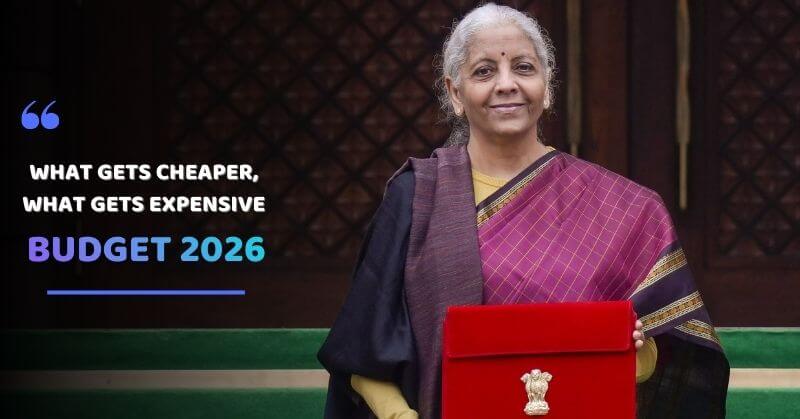
The Union Budget is always more than numbers on paper. It decides what becomes easier on the wallet and what pinches a little more. With Finance Minister Nirmala Sitharaman presenting her record ninth Budget, Budget 2026, in Parliament on February 1, all eyes were on how it would impact daily life.
Last year, Sitharaman said the government’s priorities were to accelerate growth, ensure inclusive development, support industry, and uplift household sentiment, with a clear focus on boosting the spending power of India’s growing middle class.
This year, the tone continues along similar lines. Jobs are in focus. Capital expenditure has been raised. Income tax slabs remain untouched. But beyond macro announcements, the big question remains simple: what gets cheaper and what costs more after Budget 2026?
Here’s a clear, no-frills breakdown.
What Gets Cheaper After Budget 2026

Cancer Drugs And Rare Disease Medicines
One of the biggest relief measures announced in the Union Budget 2026–2027 is for cancer patients and their families. Finance Minister Nirmala Sitharaman announced the removal of basic customs duty on 17 cancer-related drugs and medicines.
Sitharaman said that the duty exemption would directly help reduce the prices of critical drugs used across multiple cancer treatments. Imported oncology medicines often attract basic customs duty, contributing significantly to their final retail price.
In addition, seven more rare diseases have been brought under customs duty relief. Under this proposal, personal imports of drugs, medicines, and foods for special medical needs used in the treatment of these rare diseases will be exempt from import duties. This move will benefit patients who rely on niche therapies not manufactured in India and often imported on a named patient basis, reports NDTV.
Overseas Tourism Packages
Planning an international holiday just became less stressful on the budget. The tax collected at source (TCS) on overseas tourism packages has been sharply reduced to 2 per cent, down from the earlier range of 5 per cent to 20 per cent.
This is expected to significantly lower upfront costs for travellers.
Foreign Education
Families sending students abroad also have reason to breathe easier. A lower TDS has been announced under the Liberalised Remittance Scheme for education-related expenses. This should reduce the financial burden on parents funding overseas education.
Microwave Ovens And Household Appliances
Microwave ovens will become more affordable as the Basic Customs Duty has been exempted. This is a small but welcome relief for households looking to upgrade kitchen appliances.
Shoes, Sports, And Manufacturing Push
Shoe upper exports will get cheaper, with duty-free exports now allowed. This is expected to support India’s footwear manufacturing ecosystem.
With a renewed focus on sports and the Khelo India mission, sports equipment is also likely to become more affordable, boosting grassroots participation.
Aviation, Energy, And Strategic Sectors
In a major push to strengthen India’s aviation ecosystem, Finance Minister Nirmala Sitharaman in her Union Budget 2026 speech, proposed exempting basic customs duty on components and parts required for the manufacture of civilian, training, and other aircraft.
Several other exemptions include:
- Energy transition equipment
- Solar glass ingredients
- Capital goods for critical minerals
- Goods imported for nuclear power projects
- Fish catch by Indian fishermen in Indian waters
- Personal-use imports, with BCD cut to 10% from 20%
What Gets Costlier After Budget 2026
Luxury Goods
Certain luxury items, including watches and imported alcohol, are set to become more expensive following the Budget speech. This aligns with the government’s approach of taxing discretionary spending.
Coffee-Related Equipment
Coffee lovers may feel the heat. Exemptions on coffee roasting, brewing, and vending machines have been removed. This could lead to higher costs for specialty coffee outlets and premium home setups.
Fertilizers
Some fertilisers will get more expensive as the government has removed import fee exemptions on Ammonium phosphate and ammonium nitro-phosphate. These are widely used in the manufacture of manure and complex fertilisers.
Futures, Options, And Stock Trading
Traders will need to factor in higher transaction costs. Sitharaman announced a hike in Securities Transaction Tax on derivatives.
- STT on Futures has been raised to 0.05 per cent from 0.02 per cent
- STT on Options has been increased to 0.15 per cent from 0.1 per cent
This makes futures and options trading more expensive.
Income Tax Misreporting
The government has sent a strong compliance signal. Misreporting of income tax will now attract a penalty equal to 100% of the tax amount. Non-disclosure of movable assets will also attract penalties.
The Bigger Economic Context
This year’s Budget comes amid concerns over slowing global and domestic growth. India’s GDP growth for FY27 is projected at 6.8% to 7.2%. The government is clearly attempting to strike a balance—supporting consumption, protecting vulnerable sections, and maintaining fiscal discipline.
Conclusion
Budget 2026 may not bring dramatic income tax relief, but it quietly reshapes household spending in meaningful ways. Life-saving medicines get cheaper. Travel and education abroad become more accessible. Strategic sectors receive a boost.
At the same time, luxury consumption, speculative trading, and tax non-compliance face tighter scrutiny. For the average Indian, the message is clear: essentials are being protected, growth sectors are being supported, and accountability is non-negotiable.
As always, the true impact will unfold over the months ahead—but for now, Budget 2026 clearly tells us what’s lighter on the pocket and what demands deeper pockets.
Follow Us: Facebook | Instagram | X |
Youtube | Pinterest | Google News |
Entertales is on YouTube; click here to subscribe for the latest videos and updates.