

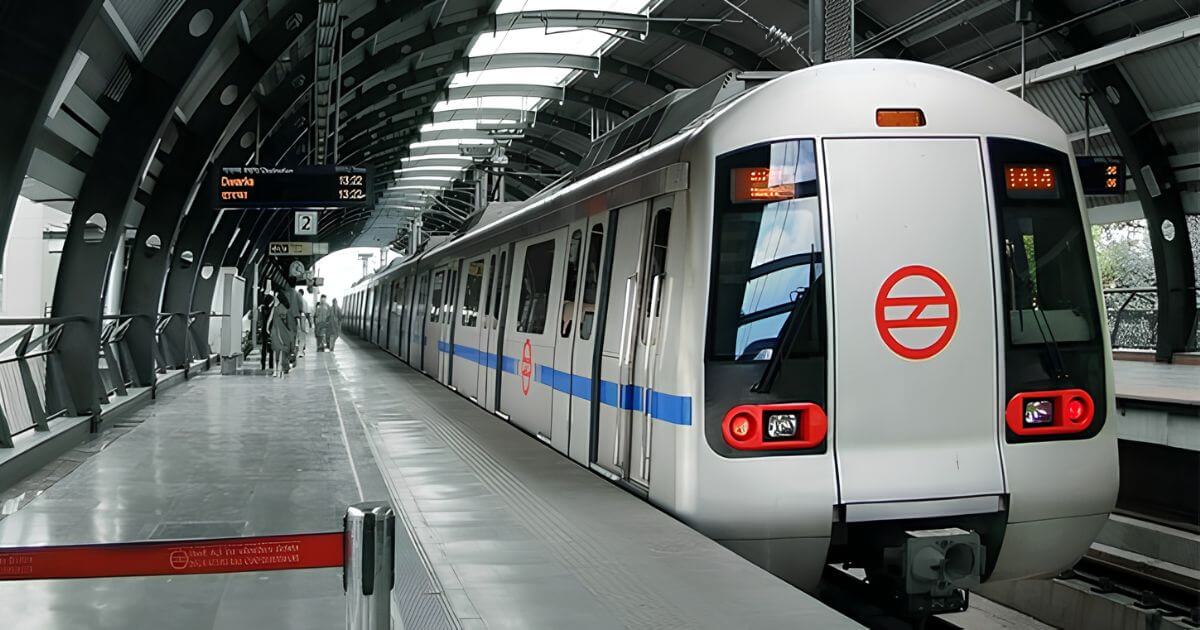
For millions of Delhi-NCR commuters, the Metro is more than just a mode of transport. It is part of everyday life. From early morning office runs to late evening journeys, passengers depend on it to reach their destinations on time. Now, the Delhi Metro has achieved a remarkable operational milestone.
The Delhi Metro Rail Corporation (DMRC) has recorded a 99.95% punctuality rate in 2026, according to the figures provided for the latest report. The performance puts the network among the world’s most reliable major metro systems. It becomes even more notable when considered alongside the scale of the network and the number of passengers it carries every day.
The Delhi Metro has continued to expand while handling a massive increase in passenger demand. Maintaining such a high level of punctuality across a complex urban rail system is a major operational achievement. Delhi Metro has also historically maintained very high punctuality levels; earlier data showed more than 99% of train trips being completed on time over several years.
Delhi Metro Network Has Grown To 416.5 Km

The Delhi Metro’s journey has come a long way since its first operations. The network initially covered only 8.4 km. Today, it has expanded to approximately 416.5 km, connecting 303 stations across 12 lines. That scale makes the latest punctuality figure particularly significant. Running a handful of trains on a short route is very different from managing a massive network spread across the Delhi-NCR region.
Every day, thousands of train movements have to be coordinated. Signalling systems, station operations, maintenance work, train availability and passenger movement all need to work together. The network is also continuing to expand. In March 2026, two new corridors helped complete India’s first fully operational Metro ring corridor, further strengthening connectivity across several parts of Delhi.
More Than 64 Lakh Passenger Journeys Every Day
The Delhi Metro is also dealing with enormous passenger demand. The network now handles an average of around 64.06 lakh passenger journeys every day. The scale of ridership has increased substantially as new corridors and stations have opened. In August 2025, the system recorded more than 81 lakh passenger journeys in a single day, showing just how heavily the Metro is relied upon by commuters.
Maintaining a 99.95% punctuality rate while serving such a large passenger base requires more than simply running trains according to a timetable. It involves continuous monitoring, maintenance, signalling and quick responses whenever technical problems occur. For commuters, even a few minutes of delay can have a major impact on office timings, connecting transport and other daily commitments. That makes reliability one of the most important factors in the success of a mass-transit system.
Delhi Metro Among World’s Top Five
The reported 99.95% punctuality rate places Delhi Metro among the top five most reliable metro systems globally, according to the comparison highlighted in the report. Its performance has been reported as better than several internationally recognised metro networks, including systems in Hong Kong, Paris and New York. This gives India’s capital a strong position on the global urban transport map.
Delhi Metro has also previously been recognised as one of the better-performing metro systems in terms of punctuality. Earlier comparisons placed it in the same broad league as highly regarded systems such as London’s Underground and Tokyo’s subway. The latest figure, however, stands out because it comes at a time when the network is significantly larger and busier than it was during those earlier comparisons.
Technology Is Playing A Bigger Role
Technology has become another important part of Delhi Metro’s push towards greater reliability. The network has increasingly adopted modern signalling, automated monitoring and advanced operational systems. Driverless Metro services have also added another dimension to its technology-led approach. Automation can help reduce the possibility of human error in certain operational functions while allowing systems to monitor train movements more efficiently. Modern signalling is equally important. A large Metro network cannot function smoothly without precise coordination between trains, stations and control centres.
The combination of technology and human expertise allows DMRC to respond to disruptions while maintaining regular services across the network. However, the Metro is not completely immune to operational problems. In April 2026, for instance, a signalling issue disrupted services on part of the Magenta Line for nearly eight hours. That makes the reported 99.95% overall punctuality figure even more reflective of the network’s performance across the wider system rather than suggesting that delays never occur.
Expansion Has Not Come At The Cost Of Reliability
One of the biggest challenges for any growing public transport network is maintaining service quality while expanding. Delhi Metro has continued to add new corridors, stations and interchanges. At the same time, passenger demand has grown. The network’s expansion is far from over. In May 2026, the Delhi government approved seven new Metro corridors covering nearly 100 km with 65 stations under the next phase of expansion.
A new 9.9-km Central Vista Metro corridor is also under construction, with eight stations planned as part of the Magenta Line extension. As the network becomes larger, keeping trains punctual will become an even bigger operational challenge.
A Major Achievement For India’s Public Transport
Delhi Metro’s performance has significance beyond the capital. Metro networks are expanding rapidly across Indian cities as governments look for alternatives to congested roads and growing private vehicle use. Delhi’s experience shows that a large urban rail system can continue to expand while maintaining a very high level of operational reliability.
The Metro also plays an important role in connecting Delhi with parts of the wider NCR. Its network serves commuters travelling across Delhi and neighbouring cities, making punctuality important for millions of daily journeys. The system’s scale has also made it a crucial part of the capital’s transport infrastructure.
Conclusion
Delhi Metro’s reported 99.95% punctuality rate in 2026 is a major achievement for one of India’s busiest public transport networks. The figure becomes even more impressive when viewed alongside its 416.5-km network, 303 stations and more than 64 lakh daily passenger journeys.
The network continues to expand, adopt new technology and handle rising passenger demand. Maintaining reliability while taking on this growing workload will remain a challenge, but the latest performance shows that Delhi Metro is currently operating at an exceptionally high level.
For millions of commuters, the achievement ultimately comes down to one simple thing: getting where they need to go, when they need to get there. And on that front, Delhi Metro continues to set a high benchmark for urban transport in India.
Follow Us: Facebook | Instagram | X |
Youtube | Pinterest | Google News |
Entertales is on YouTube; click here to subscribe for the latest videos and updates.