

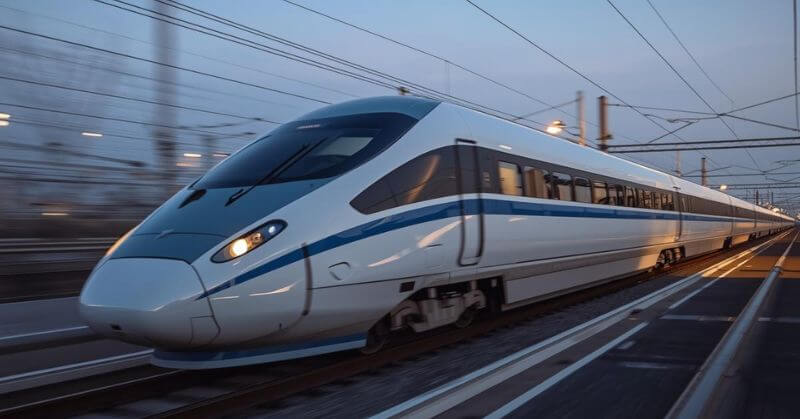
For most of us, trains are familiar. The rumble of wheels on rails. The rhythmic clatter. The feeling of movement that tells your body you’re travelling fast. Now imagine all of that disappearing. No noise. No vibration. Just smooth, silent motion — and a speed so unreal it doesn’t register until you look at the numbers. That’s exactly what Japan’s maglev train delivers, rewriting everything we thought we knew about distance, speed, and the future of rail travel.
The new maglev train has a record of 603 km/h, and it completely transforms the experience of distance. This is not just a new step in rail technology, but a rethinking of what trains are capable of. Although the majority believe that trains are something that rattle down tracks, producing a clicking sound, the maglev system in Japan takes that whole idea and throws it out of the window. It is not only impressive that the maglev train reaches a speed of 603 km/h, but it also seems entirely natural and peaceful as it does so. This breakthrough is the peak of engineering innovation and offers a glimpse of the future of transport.
Speed And Distance — Maglev Redefined
There is no shaking within the train, no dramatic movement, no sparks — just a gliding motion and the sense that the outside world is getting left behind. This experience questions all that passengers know about travelling by train.
The interior is clean and white, with soft lighting and seats that look like those in an airport lounge. The design is centered on comfort, not on reminding passengers that they are travelling at breathtaking speeds.
A passenger may think that the train is moving at approximately 150 km/h without knowing the real speed. That is the strangest aspect of this technology — your body gets no information that you are travelling at approximately 375 miles an hour.
The brain feels that this is not what trains are meant to be like, even in such a quiet setting. Humans have spent over 100 years accustomed to hearing wheels on rails, and this train takes away that familiar soundtrack. By eliminating those known sounds, the train transforms how people envision travelling.
The Historic Record: L0 Series Maglev Breaks The World Speed Record
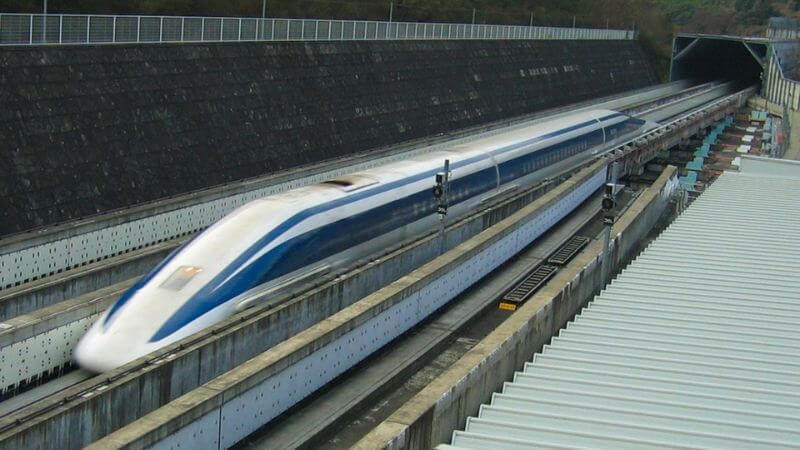
This record was set in Japan on a special test track using a specially prepared maglev unit designed for controlled high-speed trials. The L0 Series maglev reached a maximum velocity of 603 km/h in April 2015, breaking its own previous record of 590 km/h and surpassing all other high-speed train records worldwide. It became the fastest train on Earth at that time.
On paper, it’s all numbers and specifications. Inside the cabin, it becomes a deeply human experience. An experienced Shinkansen driver rests his hand on the armrest rather than the controls. A safety engineer watches live graphs that remain nearly flat. Journalists lean forward, waiting for the digital speedometer to flick from 599 to 600.
Think of it this way. It feels like checking your car’s speedometer, realizing it’s inaccurate, and then mentally multiplying that speed by six. And yet, despite moving at extraordinary speeds, passengers don’t feel fear. They feel calm. They feel safe.
Understanding Maglev Technology
Maglev stands for magnetic levitation. Unlike conventional trains, the maglev does not move on wheels. Instead, it is suspended above the track and propelled using powerful magnetic fields. Because there is no physical contact, there is no friction. Without friction, the traditional limits of steel-on-steel rail travel disappear.
This technology uses strong electromagnets to lift the train about 10 centimetres (4 inches) above the guideway. The same magnetic force both lifts and propels the train forward, enabling it to reach extraordinary speeds with remarkable stability.
The maglev train isn’t just fast. It’s unsettling in the best possible way. It forces the mind to recalibrate what speed feels like and what travel should sound like. At 603 km/h, there’s no chaos, no thrill-seeking drama — just silence, precision, and confidence in engineering done right.
What Japan has achieved with maglev isn’t merely a record. It’s a preview. A future where distance shrinks, time bends, and travel becomes less about endurance and more about experience. Once you understand maglev, ordinary trains suddenly feel like relics of another era.
Follow Us: Facebook | Instagram | X |
Youtube | Pinterest | Google News |
Entertales is on YouTube; click here to subscribe for the latest videos and updates.