
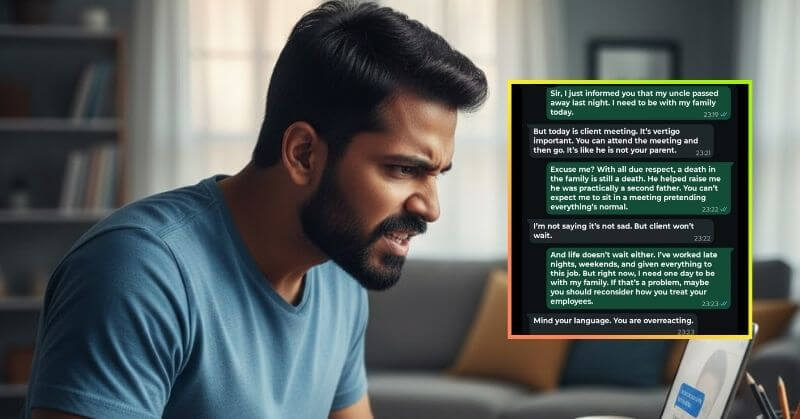
In today’s fast-paced work environment, empathy is becoming rare. A recent viral WhatsApp chat between a Gen Z employee and his boss has once again highlighted how compassion is often missing from modern workplaces. What should have been a simple request for understanding turned into a shocking display of insensitivity. The incident has since sparked a widespread debate online, raising important questions about corporate culture and basic human decency at work.
What Exactly Happened In The Viral WhatsApp Chat?
Only Gen-Z can change the toxic Indian Work Culture
Salute to this guy pic.twitter.com/5xFLzvB7i7
— Oxygen 💨 (@WhateverVishal) November 15, 2025
The conversation began when the employee informed his manager that his uncle had passed away and he needed the day off to be with his family. Instead of offering condolences, the manager insisted that he must attend a scheduled client meeting before taking leave.
The employee explained that his uncle was like a second father to him, and joining a meeting while grieving was impossible. Despite this, the manager continued to push, even telling him he was “overreacting” and suggesting consequences if he did not cooperate.
The Employee’s Reaction Offends The Boss
The shared screenshots show the boss accusing the worker of overreacting and disrespecting his superiors. The employee stood his ground and replied that he was only asking for “basic human decency.”
This triggered the manager further. He threatened HR action and said the leave would be marked as LWP. Shockingly, he also demanded a death certificate to justify the absence. The conversation ended with the manager asking him to speak to HR the next day.
Social Media Users Praise The Employee’s Courage
As soon as the screenshots surfaced online, social media erupted. Thousands of users jumped in to support the employee and criticize the boss’s cold reaction.
One user commented, “Any boss who says ‘client won’t wait’ when someone’s relative has died shouldn’t be managing people. He should be managing Excel sheets in a dark room where no human interaction is required.”
Another user shared, “I lead a team of eleven people. Emergencies happen all the time. I’ve approved leaves simply by informing upper management. My team always supports me because respect is mutual.”
Someone else added, “Clients are usually understanding. It’s the employer or manager who makes things difficult.”
Another person pointed out, “If word gets out about which company this is, the manager can get fired just for his first response—forget the rest.”
Meanwhile, one user commented on workplace culture, saying, “I’ve worked with Indian and foreign clients. The worst clients are Indian. They don’t treat you like people; they treat you like dirt.”
Not everyone agreed entirely. A few felt the employee pushed too hard. They argued they would have stopped responding and replaced him instead of escalating the chat.
Conclusion
This viral WhatsApp chat is much more than a disagreement between an employee and a boss. It reflects deeper issues within today’s work culture—poor leadership, lack of empathy, and the normalization of emotional insensitivity. What should have been a moment of compassion turned into a power struggle. The incident has encouraged a broader conversation about mental health, workplace boundaries, and the need for kinder leadership. In a world where pressure is constant, empathy shouldn’t be rare. It should be the norm.
Follow Us: Facebook | Instagram | X |
Youtube | Pinterest | Google News |
Entertales is on YouTube; click here to subscribe for the latest videos and updates.