
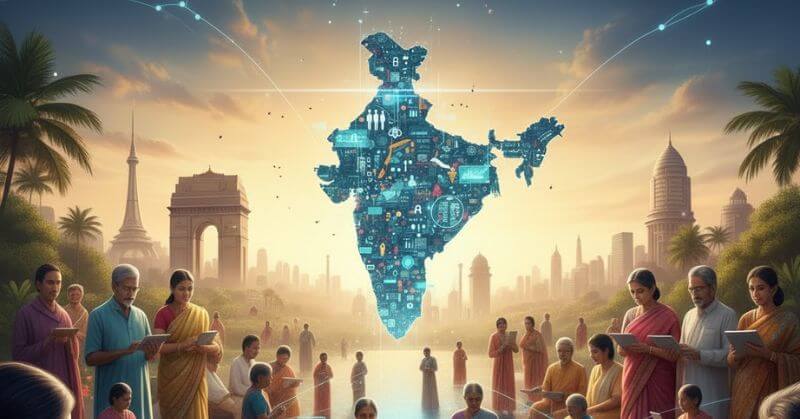
India is preparing for one of the biggest administrative transformations in its history. The upcoming 2027 Census is expected to go completely digital — no paper forms, no manual headcounts, and no endless data-entry delays. For a country as vast and diverse as India, this shift is not just a technological upgrade. It marks a fundamental change in how the nation counts, understands, and governs its population.
Yes, quicker data, more intelligent governance, and instantaneous judgments. However, what about millions of people who could find it difficult to use digital platforms, data privacy, and access gaps? The question of whether India is prepared for a totally digital Census emerges as the country gets ready for its most ambitious data collection project to date.
India’s 2027 Census Will Be Completely Digital
India is getting ready for a momentous change. The upcoming Census, which is set for 2027, will be the first to be carried out solely digitally. The exercise, which was originally scheduled for 2021 but was postponed because of COVID-19, will now use an online self-enumeration portal and mobile apps instead of the decades-old paper-based model.
The Ministry of Home Affairs has announced that while residents who want to submit their information online can do so using a secure Census web page, enumerators will use a specifically created software on their mobile smartphones (iOS and Android). The Census Management and Monitoring System (CMMS) will be used to track the entire process in real time.
“It has been decided to conduct Census 2027 through digital means,” said Nityanand Rai in Parliament. Additionally, respondents can use a web portal to self-enumerate along with the standard household and demographic data. He added that each person’s migration-related details, such as birthplaces, previous residences, length of stay, and reasons for relocation, will be documented.
With this change, India joins nations that currently use digital or hybrid approaches, such as the US, UK, Ghana, and Kenya. However, India’s attempt is unique because of its enormous size, which includes nearly 1.4 billion people from thousands of languages, geographical locations, and socioeconomic backgrounds.
How The Digital Survey Will Be Performed
There will be two stages to the census:
- Mapping and listing of houses: April–September 2026
- February–March 2027 is when the population will be counted (with special procedures for snow-bound locations).
Principal Benefits Of A Digital Census
Many long-standing issues with paper surveys are resolved by moving to digital tools.
- Quicker Outcomes: Provisional data could be accessible in about 10 days rather than years, and final findings are anticipated in 6–9 months, which is a significant improvement over previous timescales.
- Improved Planning of Policy: Decisions like this can be directly influenced by faster, more precise data.
* 2029 parliamentary constituency boundaries
* Allocation of welfare funds
* Planning for urban-rural development - Increased Precision: Human error is decreased by geotagging, in-app verification, and real-time uploading. Self-enumeration with a distinct verification ID will make it easier to follow populations that migrate or move around frequently.
- Economical: There is no need to buy 30 lakh tablets when enumerators use their own smartphones. In addition to creating around 24 million person-days of employment and saving crores that would have been spent on paper scanning, the project has a budget of ₹14,618 crore.
- Design That Is More Inclusive: Multiple languages are supported via the interface, and in places with unreliable connectivity, paper forms are an option. GPS mapping and AI-based error detection provide an extra degree of dependability.
Challenges And Dangers
The percentage of Indians with regular internet access is only around 65%. There is still a risk of undercounting people who are already marginalized in remote rural belts, hilly regions, and tribal communities due to poor or nonexistent network connectivity.
- Issues with Digital Literacy: A significant amount of digital training will be needed for the three million enumerators, who are frequently school teachers. Without assistance, elderly people, households with poor literacy rates, and foreign workers may be reluctant or find it difficult to use app-based solutions.
- Privacy and Data Security: Digital storage will now be used for sensitive data like caste and migration history. To stop data leaks or misuse, secure storage, device-level security, and encrypted transmission become essential.
A Pivotal Moment For India
The 2027 Census has the potential to completely change how India counts, comprehends, and plans for its population. It might become one of the world’s fastest, most transparent, and most accurate population records if everything goes according to plan. However, whether this revolution succeeds or leaves some folks behind will depend on digital access, training, and data protection.
Conclusion
India’s fully digital 2027 Census could redefine how population data is collected, analysed, and used for policy-making. Faster results, smarter governance, and better planning are within reach. But the success of this transformation will depend on one crucial factor — inclusion. If digital access, training, and data protection are handled carefully, this Census could become a global model. If not, it risks deepening existing gaps. The next two years will decide which path India takes.
Follow Us: Facebook | Instagram | X |
Youtube | Pinterest | Google News |
Entertales is on YouTube; click here to subscribe for the latest videos and updates.